
The Rise of Pre-Idea Funding: How Venture Capital Is Betting on Talent Before the Business Plan
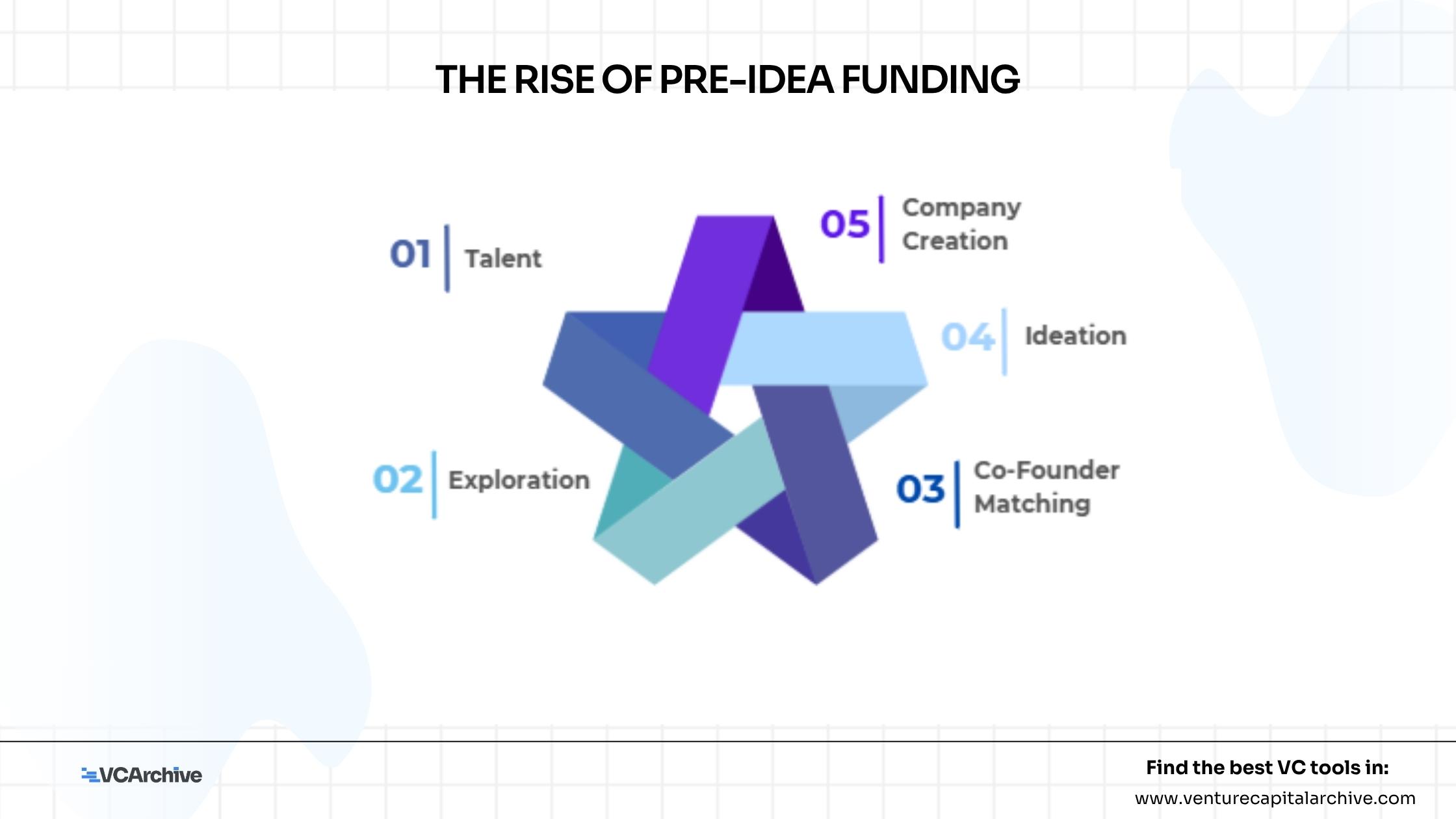
In traditional venture capital, the progression of startup financing follows a familiar script: a founder identifies a massive problem, formulates a clever solution, builds a pitch deck, creates a minimum viable product (MVP), and presents early traction to investors. From pre-seed to Series A, capital allocation historically hinged on validating a specific business model, market size, and product concept.
However, a fundamental shift is underway at the very edge of innovation. A growing wave of venture firms, talent accelerators, and venture studios are introducing pre-idea funding — a model where capital is deployed to exceptional individuals before a company, product, or even a concrete business idea exists.
Often referred to as “Day-Zero” or “talent-first” investing, pre-idea funding flips the traditional venture model on its head. Instead of evaluating pitch decks and market sizing, investors back high-potential founders, giving them the financial runway, mentorship, and environment needed to ideate, form teams, and launch new companies from scratch.
Defining Pre-Idea Funding vs. Traditional Stages
To appreciate how pre-idea capital functions, it helps to distinguish it from adjacent early-stage rounds:
- Seed & Series A: Focus on scaling proven product-market fit, expanding distribution, and growing repeatable revenue.
- Pre-Seed Funding: Capital raised to build an initial prototype (MVP), perform early customer discovery, or test core market hypotheses around a defined concept.
- Pre-Idea Funding: Capital provided to an individual or unformed team who has not yet settled on a business idea or problem statement.
At the pre-idea stage, there is no cap table, no product specification, and no target demographic. The investment thesis relies entirely on underwriting human potential, adaptability, and execution capability.
The Core Thesis of Pre-Idea Capital: Great founders are the scarce resource in innovation, not ideas. If you assemble top-tier talent and provide them with runway and freedom, venture-scale ideas naturally follow.
Why Investors Are Moving to Day-Zero
The migration toward pre-idea investing is driven by structural changes in tech, venture capital dynamics, and human capital markets.
1. High Competition for Top Founders
Venture capital funds have expanded dramatically, creating intense competition for high-quality deals. By the time a brilliant engineer or serial operator incorporates a company and drafts a pitch deck, dozens of VC firms are competing to lead their pre-seed round. By investing at the pre-idea stage, forward-thinking funds establish relationships with world-class talent before the competitive bidding process begins.
2. The Fallacy of the “Fixed Pitch Deck”
Experienced venture capitalists recognize that most successful startups pivot significantly from their original pitch deck. Instagram began as a location check-in app called Burbn; Slack started as an internal communication tool for a video game company. Because early-stage ideas frequently change, backing the founder’s raw problem-solving capability yields higher long-term success than betting on an unproven initial concept.
3. Lower Cost of Technical Prototyping
Advancements in cloud infrastructure, developer tools, AI code generation, and low-code platforms have drastically reduced the capital required to build software. Today, the primary bottleneck in creating a tech company is rarely the technical cost of building an MVP — it is the strategic clarity to select the right problem to solve. Pre-idea programs grant founders structured time to explore dozens of concepts before committing capital to build.
How Pre-Idea Funding Models Work
Pre-idea capital is disbursed through several primary organizational structures:
Talent Accelerators & Residency Programs
Organizations such as Antler and Entrepreneur First operate residency programs designed specifically for pre-team, pre-idea individuals. Founders enter a cohort of dozens of vetted engineers, domain experts, and operators. During the program:
- Participants receive a stipend or initial capital injection to cover personal living expenses.
- The environment facilitates co-founder matching, allowing participants to test working chemistry.
- Founders conduct rapid ideation and market research, validating ideas with program advisors.
- At the conclusion, teams pitch the program’s investment committee for institutional pre-seed backing.
Venture Studios and Incubators
Venture studios take a more hands-on approach. Studios often generate internal research hypotheses regarding emerging technology trends (e.g., AI workflow automation, biotech infrastructure). They hire “Founders-in-Residence” (FIRs) and fund them to explore and build around those macro themes, pairing talent with in-house design, marketing, and legal teams.
Angel Grants and Founder Fellowships
A growing number of successful founders and angel syndicates offer no-string-attached grants or uncapped SAFE notes to prospective founders. These fellowships provide $20,000 to $100,000 in non-dilutive or founder-friendly equity terms, allowing scientists, researchers, or top-tier developers to quit their day jobs and dedicate three to six months to full-time ideation.
What Pre-Idea Investors Look For
Without metrics, pitch decks, or financial projections to analyze, how do investors evaluate pre-idea candidates?
- Extreme Execution Speed: A track record of shipping projects rapidly, whether open-source software, academic research, side projects, or previous business ventures.
- Domain Expertise & Unfair Advantage: Deep technical background in emerging fields (such as artificial intelligence, robotics, or synthetic biology) or years of deep industry experience identifying friction points inside specialized verticals.
- Spike & Grit: A distinct, world-class capability — be it exceptional engineering prowess, rare sales capability, or deep product intuition — combined with the resilience to withstand early rejection.
- Founder Magnetism: The ability to attract world-class co-founders, early employees, and advisors purely through vision and personality.
Benefits and Challenges for Entrepreneurs
Advantages
- Freedom to Explore: Removes the financial anxiety of quitting a stable job, enabling risk-free exploration.
- Co-Founder Discovery: Solves one of the hardest challenges in entrepreneurship: finding a compatible co-founder with complementary skills and matching ambition.
- Structured Validation: Provides frameworks to stress-test ideas before wasting months or years building something the market does not want.
Potential Drawbacks
- Early Equity Dilution: Joining a structured accelerator or studio at the pre-idea stage may require giving up 7% to 15% equity early on in exchange for the initial stipend and program access.
- Time Pressure: Cohort-based programs often enforce strict deadlines (e.g., 8–12 weeks to find a co-founder and validate an idea), which can feel artificial or rushed for complex deep-tech concepts.
The Future of Day-Zero Capital
Pre-idea funding represents the ultimate democratization of early-stage venture creation. Traditionally, leaving a lucrative job to spend six months exploring business ideas was a luxury reserved for those with substantial personal savings or wealthy personal networks.
By institutionalizing talent-first investing, the venture ecosystem opens doors for exceptional talent regardless of financial background. As AI and automated tools continue to accelerate product development, the value of the “idea” itself will continue to fall — while the premium placed on exceptional, adaptable human execution will reach unprecedented heights. Pre-idea funding is not merely a transient investment trend; it is becoming the foundational starting line for the next generation of global technology companies.
This article was originally published on Medium by Mohamed Gamal and has been sourced here for educational purposes
More from Mohamed Gamal
No other articles from this author yet. Visit their profile.